

By Robert Majdak Sr. MBA
Management Insights Group, LLC
June 21, 2026
For-Profit Companies and Non-Profit Organizations
Every organization that earns more than it spends must answer a fundamental question: what happens to the surplus? For-profit companies record the answer as retained earnings, while nonprofit organizations record it as net assets. The two accounts serve a similar economic purpose, preserving accumulated surplus to underwrite future activity, yet they rest on different ownership structures, accounting regulations, and reporting statements. Understanding both accounts sharpens how leaders interpret organizational financial health across either sector.
Retained Earnings in For-Profit Companies
Retained earnings is the cumulative profit a company has retained rather than paid out to shareholders as dividends. It appears in the stockholders’ equity section of the balance sheet, and it grows or contracts each period through a straightforward relationship: beginning retained earnings, plus net income, minus any dividends, equals ending retained earnings. A profitable year that pays modest dividends increases the balance, while an operating loss reduces it. When losses accumulate beyond past profits, the account becomes negative and is designated an accumulated deficit.
The balance carries considerable strategic weight. Retained earnings represent capital a business can reinvest without borrowing or issuing additional shares. Boards continually weigh that internal funding against the expectations of owners who want dividends today. The figure also signals managerial discipline, because a steadily rising balance suggests durable profitability, while erratic fluctuations invite closer scrutiny from investors and lenders.
Net Assets in Non-Profit Organizations
Nonprofit organizations have no shareholders and distribute no profit, so they do not report retained earnings. Instead, accounting regulations require them to report net assets, which is the difference between total assets and total liabilities. Net assets serve the same structural role that equity serves in a business, but the vocabulary and the rules reflect the absence of private ownership.
Under current standards, nonprofits divide net assets into two classes: net assets without donor restrictions and net assets with donor restrictions. The unrestricted class is the closest parallel to retained earnings, because leadership may allocate it freely toward the mission. The restricted class holds contributions that donors have limited to a specific purpose or time period, and it cannot be expended at management’s discretion. Rather than reporting net income, a nonprofit reports a change in net assets, and that change flows into the ending balance much as net income flows into retained earnings.
Where the Two Diverge
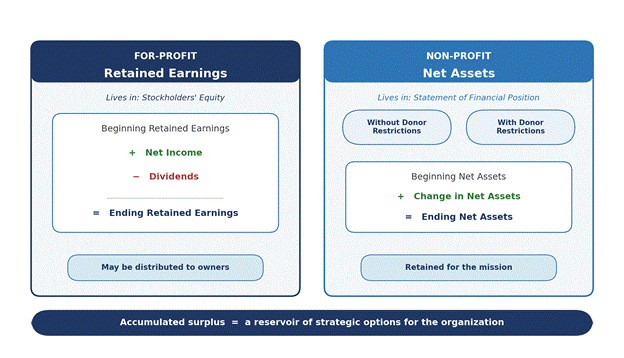
Figure 1. Parallel structure of retained earnings and net assets.
The accounts share a common logic, yet several meaningful differences matter for anyone interpreting the statements. For-profit companies report results on an income statement and a balance sheet, while nonprofits use a statement of activities and a statement of financial position. For-profit firms can distribute earnings to owners, whereas nonprofits must retain every surplus for the mission. Most important, donor restrictions impose a layer of accountability that has no equivalent in the for-profit account, since shareholders establish no comparable limits on how a company spends its retained profit.
Why It Matters to Leaders For executives and board members, the distinction extends well beyond terminology. A healthy retained earnings balance tells a for-profit board it can finance growth from within. A healthy unrestricted net assets balance tells a nonprofit board it can weather a funding gap or invest in new programs. In both cases, the accumulated surplus is a reservoir of strategic options, namely evidence that the organization can absorb a setback, pursue ambition, and operate without depending entirely on outside capital. Reading the correct account, with its specific rules in mind, is what enables leaders to evaluate resilience accurately in either sector.
-MIG
© Management Insights Group, LLC
Dallas/Fort Worth Texas Office