

By Robert Majdak Sr. MBA
Management Insights Group, LLC
June 14, 2026
Aligning Channel Strategy and Budget Discipline with Organizational Purpose
Every CEO eventually confronts a deceptively simple question: where should the marketing dollar go? The honest answer is that the dollar should follow the mission, not the channel fashion of the moment. Over the past two decades of advisory work with mid-market firms, I have watched leadership teams chase the newest platform, the loudest agency pitch, or the competitor’s tactic, only to discover that none of it moved the business forward because none of it was tethered to why the company exists. Mission, marketing, and messaging are not three separate disciplines. They are one continuous argument, and the channels, website, newsletter, email, text, and direct mail, are simply the vehicles that carry that argument to the people who need to hear it.
Matching the Channel to the Mission
A mission-driven channel strategy starts by asking what each audience segment needs to believe, and how quickly, before they will act. The website is the institutional anchor. It is where the mission statement, the proof points, and the depth of credibility live, and it should be treated as a permanent asset rather than a campaign. Newsletters serve the relationship layer: they nurture existing clients and prospects with a steady cadence of insight that reinforces the firm’s expertise without asking for anything in return. Email is the workhorse of direct conversion, suited for time-bound offers, event invitations, and personalized follow-up where the mission’s value proposition needs to be restated in a specific, transactional context. Texting is reserved for urgency and intimacy, appointment reminders, last-call notices, and service alerts, because its immediacy demands restraint; overuse erodes the very trust the mission is meant to build. Mailing pieces, often dismissed as outdated, retain unmatched authority for high-stakes, high-trust communications: board correspondence, annual reports, or outreach to executives who are inundated digitally and still open a well-designed envelope.
The blend, then, is not arbitrary. It should mirror the buyer’s journey: website for discovery and validation, newsletter for sustained trust, email for decision-stage nudges, text for operational urgency, and mail for moments that require gravitas. A firm whose mission centers on transformation and growth will lean harder into thought-leadership newsletters and a robust website, since both formats reward depth. A firm whose mission centers on speed and responsiveness will weight email and text more heavily, since those channels reward immediacy. There is no universal ratio; there is only the ratio that the mission itself dictates.
Allocating the Budget: Percentage of Revenue as the Starting Discipline
Funding these methods should indeed be anchored to a percentage of revenue, because revenue-based budgeting forces marketing spend to scale with the company’s actual capacity rather than with executive enthusiasm or competitive anxiety. For most service-based and mid-market firms, total marketing investment, inclusive of these five channels, should fall between six and twelve percent of gross revenue, with newer or growth-stage companies trending toward the higher end and mature, retention-driven firms trending lower. Within that envelope, and within that six and twelve percent of gross revenue I recommend the following baseline segmentation as a starting point be the breakdown, to be adjusted once performance data accumulates.
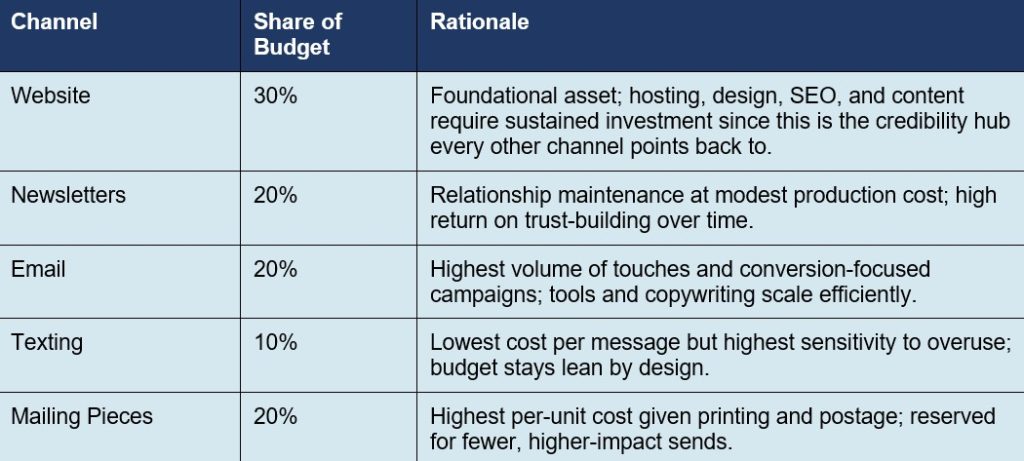
This allocation is a baseline, not a mandate. The point of expressing it as a percentage of revenue is that it remains proportionate as the company grows or contracts, and it gives the CEO a defensible answer when the board asks how marketing spend was determined.
Measuring Effectiveness Against the Right Yardstick
Spending discipline only matters if it is paired with measurement discipline, and each channel demands its own metric because each channel performs a different job. The website should be measured against organic traffic growth, time on page, and conversion rate from visitor to qualified lead, since its purpose is sustained discovery and validation. Newsletters should be measured against open rate, click-through rate, and subscriber retention over time, since their purpose is relationship durability rather than immediate transaction. Email should be measured against conversion rate and revenue attributed per campaign, since its purpose is direct action. Texting should be measured against response rate and opt-out rate in tandem, because a high response rate paired with a rising opt-out rate signals a channel being burned out faster than it is being built. Mailing pieces should be measured against response rate and, critically, against the deal size or relationship value of the recipients reached, since the channel’s purpose is impact density rather than volume.
None of these metrics should be evaluated in isolation from the others. A website with declining traffic but a newsletter with rising retention may simply indicate that the firm’s existing audience trusts it more even as new discovery slows, which is a different problem than an underperforming brand. The CEO’s job is to read the channels as a system, not as five independent scorecards.
Should Ineffective Channels Be Pared Back? Usually, but Not Reflexively
Yes, underperforming channels should be pared back, but only after two conditions are met: the channel has been given a fair runway, typically two to three full cycles of its natural cadence, and its underperformance has been isolated from confounding variables like a weak offer, poor creative, or a misaligned audience rather than a flawed channel choice. Cutting a channel after one disappointing quarter is as undisciplined as funding it indefinitely out of habit. The more sustainable practice is to treat the budget as a living allocation, reviewed quarterly, where modest underperformance triggers a tactical adjustment, refining copy, resegmenting the list, adjusting cadence, before it triggers a wholesale reallocation of dollars. Reserve full defunding for channels that, after genuine optimization attempts, still fail to clear their cost of execution relative to the value of the leads or relationships they produce.
The deeper discipline is resisting the temptation to defund a channel simply because it is harder to measure. Mailing pieces and newsletters often show their value in lengthened customer lifetime and referral behavior rather than in a clean click-through number, and a CEO who only trusts what a dashboard reports in real time will systematically starve the very channels that build the durable trust the mission depends on. The goal is not to fund every channel forever, nor to fund only what is easiest to track. The goal is to fund what the mission requires, measure it honestly, and have the discipline to adjust when the evidence, not the impatience, says it is time.
-MIG
© Management Insights Group, LLC
Dallas/Fort Worth Texas Office