
By Robert Majdak Sr. MBA
Management Insights Group, LLC
November 16, 2026
A High-Level Framework for Service Company Leadership
Over two decades of leading service companies, I have learned that business development is rarely a sales problem. It is an architecture problem. Firms that grow predictably treat business development as an operating discipline with defined inputs, measurable conversion stages, and executive accountability. Firms that stall treat it as an intermittent campaign launched whenever the pipeline runs dry. The strategies below are deliberately high-level. Leadership teams in professional, technical, and administrative service businesses can adapt each one to their own markets, capacity, and economics.
Define the Growth Thesis First
Every effective business development program begins with a growth thesis: an explicit statement of which clients the firm will serve, which problems it will solve, and why it is positioned to solve them better than the available alternatives. Without that thesis, teams chase every inquiry and proposals multiply. Margins then erode because the firm prices to win rather than to profit. I require my leadership teams to articulate the thesis in a single paragraph and to test every significant pursuit against it. The discipline sounds elementary, yet it eliminates more wasted effort than any sales methodology I have implemented.
Segment Clients by Strategic Value
Service firms frequently segment clients by industry or annual revenue, which describes the market but rarely directs investment. I segment by strategic value instead. I weigh lifetime revenue potential, gross margin, referral capacity, and alignment with the firm’s core capabilities. A modest client with exceptional referral influence may warrant more executive attention than a larger client that consumes disproportionate resources. This segmentation determines where senior leaders invest relationship time. That time is the scarcest asset any service company has.
Engineer a Repeatable Pipeline
Predictable revenue requires a pipeline with defined stages, explicit entry and exit criteria, and conversion metrics at each transition. Figure 1 illustrates the progression I implement in every organization I lead.
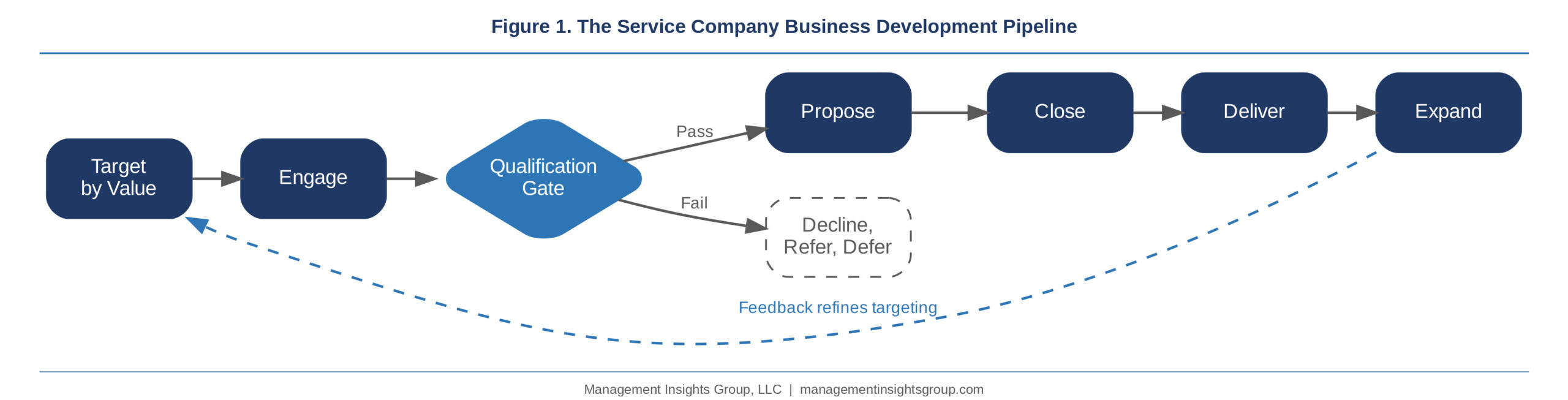
Figure 1. The service company business development pipeline
The critical element is the qualification gate. Most service firms lose money not on the opportunities they fail to win, but on the opportunities they should never have pursued. The feedback loop matters equally: delivery outcomes and client feedback must continuously inform targeting, so the pipeline becomes progressively more accurate with every completed engagement.
Enforce Disciplined Qualification
Before committing proposal resources, I require every opportunity to pass four sequential tests: strategic fit with the growth thesis, available delivery capacity, acceptable margin at a defensible price, and a credible path to the actual decision-maker. An opportunity that fails any single test is declined, referred, or deferred, as Figure 2 demonstrates.
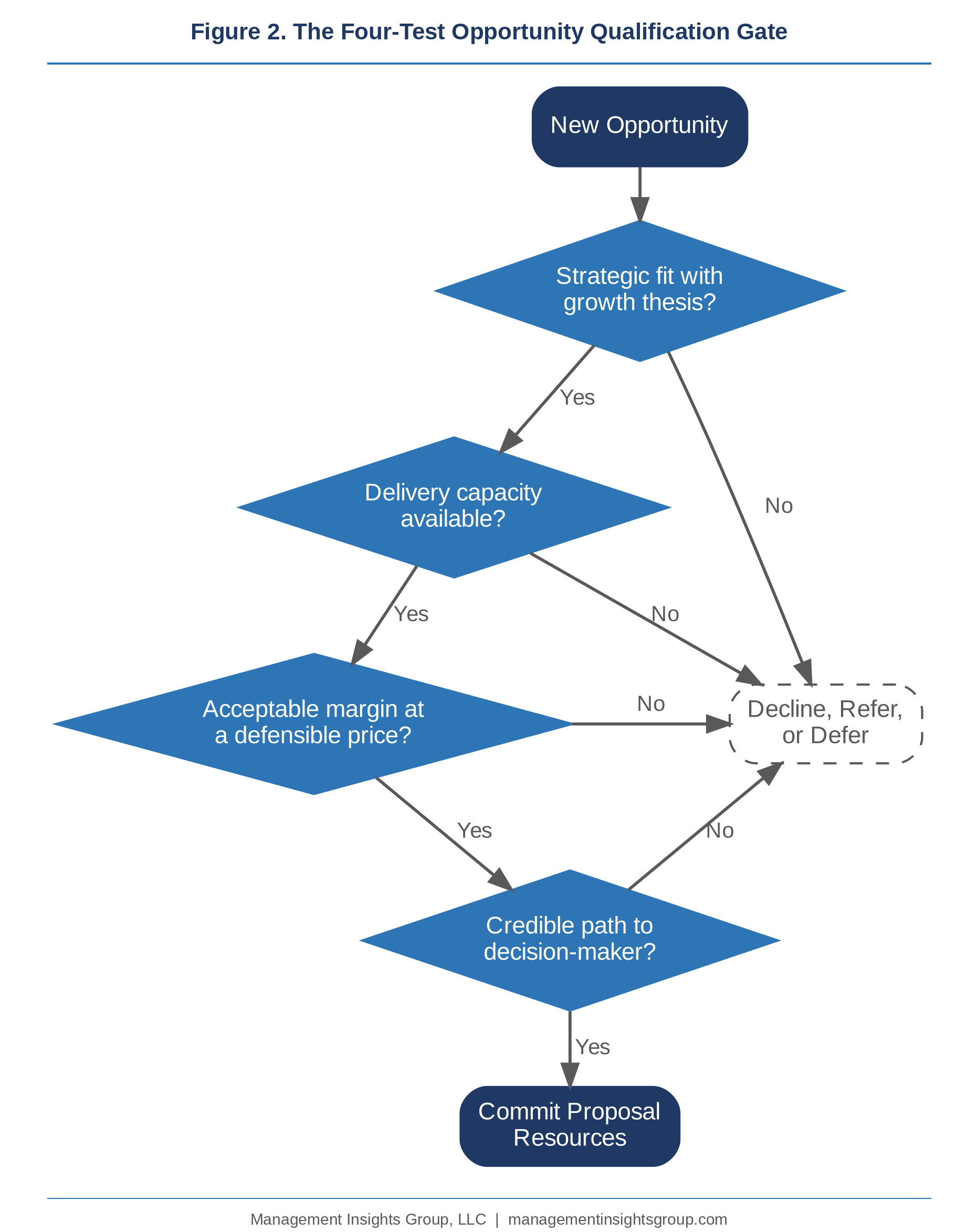
Figure 2. The four-test opportunity qualification gate
Declining work feels counterintuitive to growth-oriented leaders, yet disciplined refusal is precisely what allows a firm to commit decisively to the right engagements, protect delivery capacity, and preserve pricing integrity.
Expand Existing Relationships Systematically
Acquiring a new client typically costs considerably more than expanding an existing relationship, yet many service firms allocate business development resources almost exclusively to acquisition. The most durable growth engine is the expansion flywheel shown in Figure 3, in which exceptional delivery generates trust, trust creates access to adjacent problems, and resolved problems produce the referrals and testimonials that fuel acquisition.
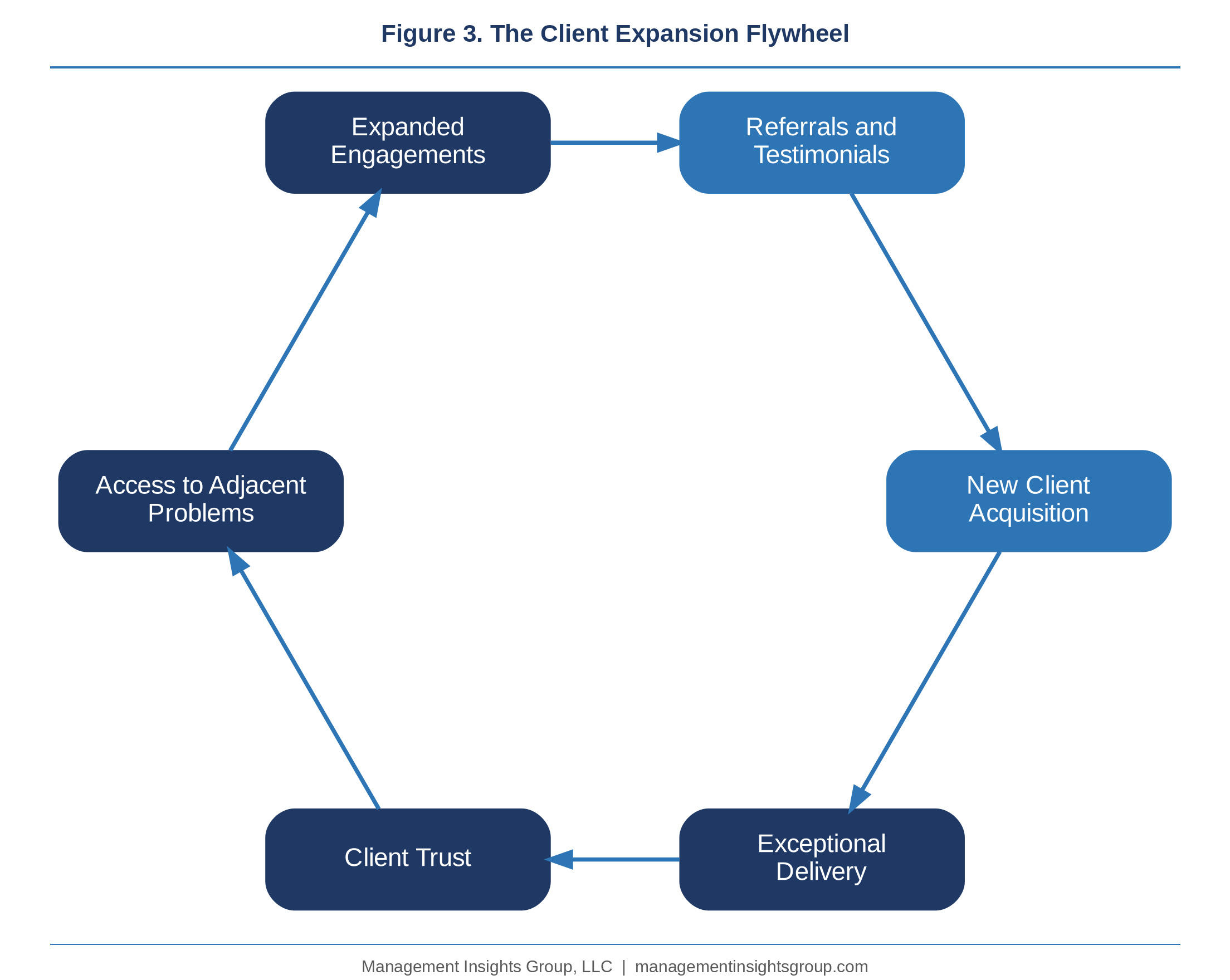
Figure 3. The client expansion flywheel
Leadership must institutionalize this cycle through structured account reviews, executive sponsorship of strategic clients, and deliberate identification of unmet needs. Expansion should never depend on fortunate conversations.
Convert Expertise into Market Authority
Service companies sell judgment, and prospective clients cannot evaluate judgment before engaging the firm. Thought leadership resolves that information asymmetry by demonstrating expertise publicly through articles, presentations, benchmark studies, and practical diagnostic tools. Authority shortens sales cycles because prospects arrive already persuaded of the firm’s competence. The conversation then shifts from whether the firm is capable to how the engagement should be structured.
Cultivate Strategic Alliances
Complementary firms that serve the same clients without competing directly represent an underutilized acquisition channel. An accounting practice, a technology integrator, and an employment law firm, for example, routinely encounter client needs outside their own scope. Formalized referral relationships, supported by reciprocal commitments and periodic executive review, generate qualified opportunities at minimal acquisition cost.
Govern with Leading Indicators
Revenue is a lagging indicator. By the time it declines, the real problem is already months old. I govern business development through leading indicators: qualified opportunities added, stage conversion rates, average sales cycle duration, proposal win rate, and expansion revenue as a percentage of total revenue. Reviewing these metrics monthly at the executive level transforms business development from an aspiration into a managed system with clear ownership and accountability.
The Executive Mandate
Business development cannot be delegated entirely to a sales function. In service companies, clients buy relationships with the people who will solve their problems. Executive credibility remains the most persuasive asset the firm owns. Leaders who define the growth thesis, enforce qualification discipline, sponsor strategic relationships, and govern through leading indicators build organizations that grow by design rather than by circumstance. I hold my own firm to that standard. Every service company leader should adopt it.
-MIG
© Management Insights Group, LLC
Dallas/Fort Worth Texas Office