
By Robert Majdak Sr. MBA
Management Insights Group, LLC
September 14, 2026
A CFO’s framework for evaluating, vetting, and directing reinvestment dollars
Every dollar a business generates has two possible destinations: it leaves the company, or it stays and goes back to work. As a CFO, I treat that choice as the single highest-leverage decision I make each quarter. Reinvestment done well compounds. Reinvestment done carelessly erodes the very cash reserves that made the decision possible in the first place. Over twenty years of sitting on this side of the balance sheet, I have settled on a disciplined, repeatable framework rather than instinct, and I want to walk you through it.
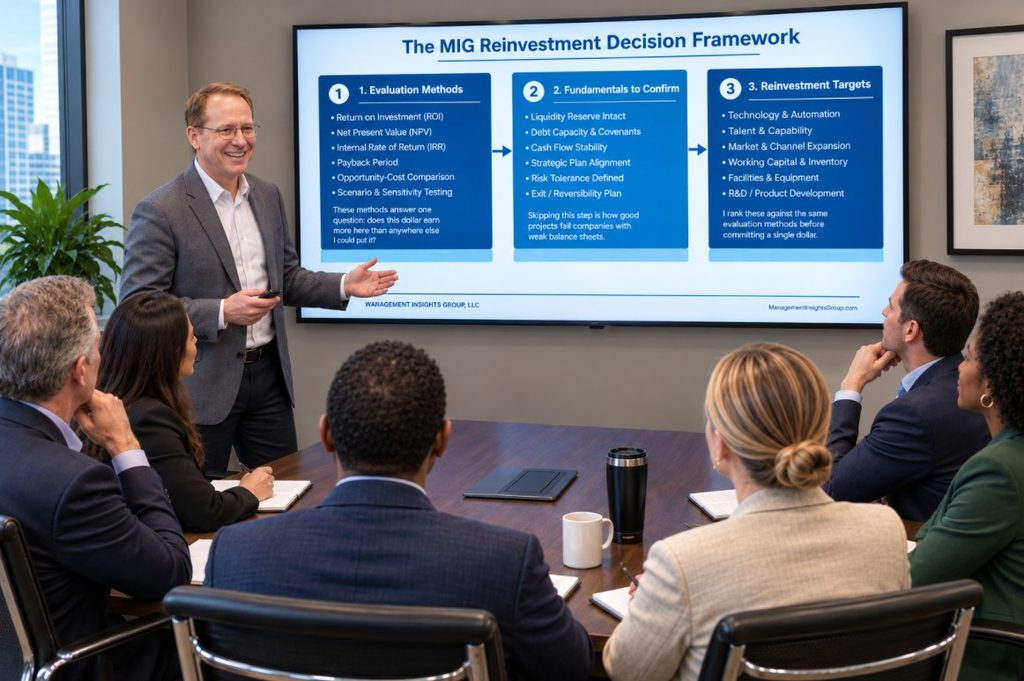
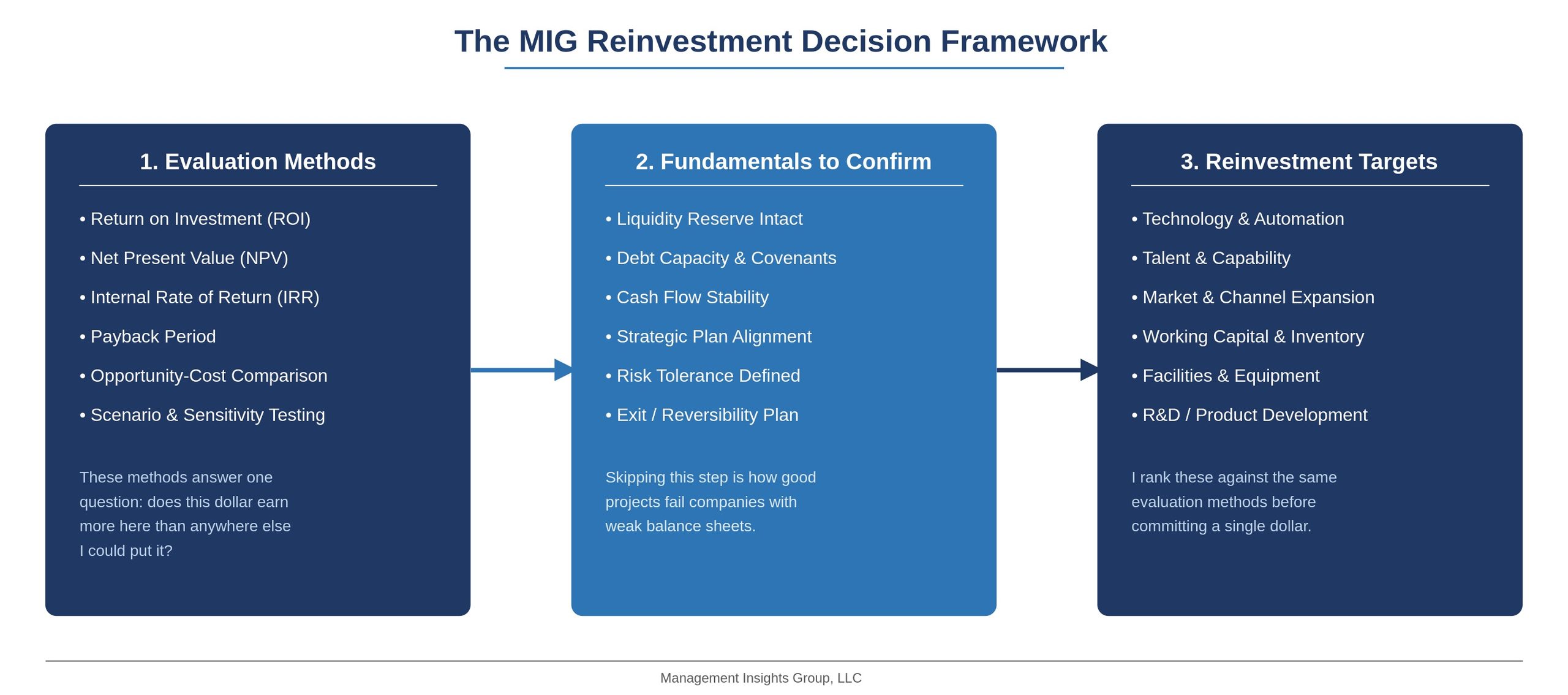
Common Methods I Use to Evaluate Reinvestment
I never rely on a single metric, because each one answers a different question and each has a blind spot.
- Return on Investment (ROI) tells me the raw payoff relative to cost, expressed simply enough for a full leadership team to debate.
- Net Present Value (NPV) discounts future cash flows back to today’s dollars, which matters enormously when a project’s benefits arrive over several years.
- Internal Rate of Return (IRR) lets me compare projects of different sizes and durations on a common percentage basis.
- Payback Period answers a simpler, more conservative question: how fast do I get my capital back if conditions turn against me?
- Opportunity-Cost Comparison forces me to weigh a proposed investment against every other use of that same dollar, including paying down debt or holding cash.
- Scenario and Sensitivity Testing stress-tests my assumptions against a downturn, a delayed rollout, or a cost overrun before I commit.
No single method carries the decision. I triangulate across at least three of these before I authorize spend above a threshold that matters to the business.
The Fundamentals I Confirm Before Committing Capital
Analysis without financial discipline is how good ideas sink otherwise healthy companies. Before I approve any reinvestment, I confirm the following, without exception.
- Liquidity reserve intact: the investment cannot draw the operating cushion below what covers a minimum of three to six months of fixed obligations.
- Debt capacity and covenant headroom: I confirm the spend does not trip a covenant or exhaust borrowing capacity I may need for an emergency.
- Cash flow stability: I look at trailing and forward-looking cash flow, not just trailing profit, since profitable companies still fail from timing mismatches.
- Strategic plan alignment: the investment must advance a stated priority, not simply present an attractive return in isolation.
- Defined risk tolerance: I set, in advance, how much of this investment the business can afford to lose outright.
- A reversibility or exit plan: if early results disappoint, I know precisely how and when I will scale back or unwind the commitment.
When any one of these fundamentals is unresolved, I delay the decision. A strong ROI on paper does not offset a weak balance sheet in practice.
Where Reinvestment Dollars Most Often Go
Across the businesses I have advised and led, reinvestment capital consistently flows toward six areas, evaluated with the same rigor described above.
- Technology and automation, to reduce unit cost and remove manual bottlenecks from finance, operations, and service delivery.
- Talent and capability, including compensation, training, and key hires that expand what the organization can execute without me.
- Market and channel expansion, whether a new geography, a new customer segment, or a new distribution channel.
- Working capital and inventory, to support growth that has already been contracted or is highly probable.
- Facilities and equipment, when capacity constraints are the binding limit on revenue rather than demand.
- Research and product development, to protect competitive position over a three-to-five-year horizon rather than the next quarter.
The discipline is not choosing among these six categories in the abstract. It is refusing to fund any of them until the evaluation methods and the fundamentals both clear the bar. I have never regretted a reinvestment I delayed for lack of certainty. I have regretted the ones I rushed. That is the standard I hold my own decisions to, and it is the standard I recommend to any CFO or owner sitting where I sit.
-MIG
© Management Insights Group, LLC
Dallas/Fort Worth Texas Office