

By Robert Majdak Sr. MBA
Management Insights Group, LLC
October 12, 2026
A Practical Primer for the New Manufacturing Accountant
Every new accountant eventually sits in a capital budgeting meeting and hears a plant manager ask whether a new machine “pays for itself,” and after twenty years in that room, I can tell you that the most defensible answer is rarely payback or accounting profit. It is net present value. This article explains how NPV operates inside a manufacturing company so that you can explain it to your controller, plant manager, and executive team with confidence.
The Core Principle: Money Has a Time Dimension
A dollar received today is worth more than a dollar received three years from now, because today’s dollar can be reinvested, retire debt, or fund operations, while a future dollar carries both opportunity cost and risk.
Net present value converts every future cash flow a project generates into today’s dollars and then subtracts the investment required to obtain those cash flows.
- A positive result means the project creates value beyond the company’s required return.
- A negative result means the company would be better served deploying that capital elsewhere.
The Three Inputs You Must Assemble
Your first input is the initial investment, which in manufacturing includes the equipment purchase price, freight, installation, rigging, operator training, and any additional working capital the project requires. New accountants routinely understate this figure by capturing only the vendor invoice.
Your second input is the incremental cash flow the project produces each year, and I emphasize both incremental and cash. Measure only the change the decision causes, including labor savings, reduced scrap, lower maintenance, higher throughput, and the tax effect of depreciation. Depreciation itself is not a cash outflow, so you exclude it from operating cash flow and include only the tax shield it creates.
Your third input is the discount rate, which finance leaders often call the hurdle rate. Most manufacturers anchor this rate to their weighted average cost of capital and add a premium for projects carrying elevated operational risk, so obtain this figure from your controller rather than inventing one.
A Worked Example: The CNC Machining Center
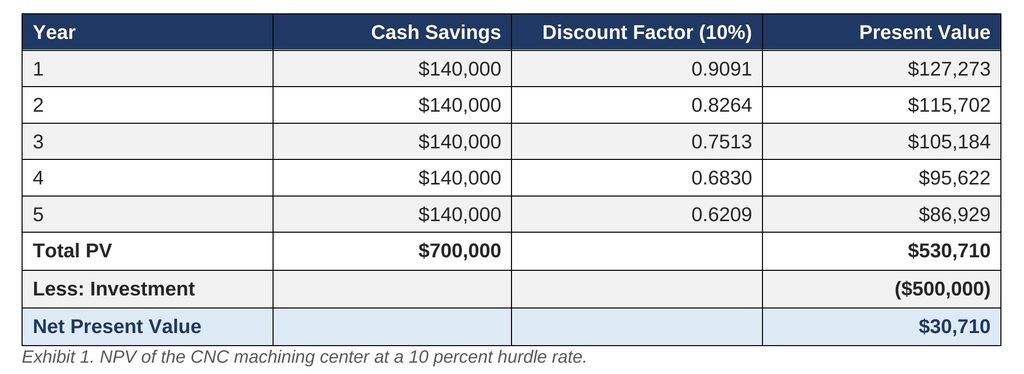
Consider a plant evaluating a $500,000 CNC machining center with a five-year useful life, where engineering and operations estimate that the machine will generate $140,000 in annual after-tax cash savings through reduced overtime, lower scrap, and faster cycle times, and the hurdle rate is 10 percent.
You discount each year’s $140,000 by dividing it by 1.10 raised to the power of that year, so year one is worth $127,273 today, year two is worth $115,702, and by year five the identical $140,000 is worth only $86,929. The five discounted amounts total $530,710. Subtracting the $500,000 investment produces a net present value of positive $30,710, meaning the machine recovers its cost, earns the full 10 percent required return, and creates an additional $30,710 of value in today’s dollars.
💎Premium Subscribers can download the data file supporting Exhibit 1.
Exhibit 1. NPV of the CNC machining center at a 10 percent hurdle rate.
Consider what the undiscounted figures would have suggested. Five years of $140,000 equals $700,000, which implies a $200,000 gain that dramatically overstates the economic benefit, and that distortion is precisely the error NPV exists to prevent.
Test the Assumptions Before You Present
A single NPV figure is an estimate rather than a fact, and experienced decision-makers know it, so before presenting, run a sensitivity analysis on the variables that carry the greatest uncertainty. In this example, if annual savings fall from $140,000 to $130,000, the NPV becomes negative $7,198 and the recommendation reverses, whereas if the hurdle rate rises to 12 percent while savings hold steady, the NPV remains positive at $4,669. This exercise tells management exactly which assumption deserves scrutiny, and here the operational savings estimate is unquestionably the critical variable.
Translating NPV for Management
Plant managers do not need the formula; they need the conclusion and its boundaries, delivered in one disciplined sentence:
“This machine creates approximately $31,000 of value above our required return, provided annual savings remain at or above roughly $132,000.”
That statement gives operations a measurable target, gives finance a defensible recommendation, and gives leadership a clear basis for approval.
Understand also where NPV fits among competing metrics: payback period answers how quickly cash returns, and internal rate of return expresses profitability as a percentage, but only NPV measures value creation in absolute dollars, which is why it should anchor the decision whenever projects compete for limited capital.
The Standard I Expect
Master net present value early, and you will earn a seat in conversations that most first-year accountants never enter. Assemble complete costs, measure true incremental cash, apply the correct hurdle rate, and stress-test your assumptions before anyone else does. Accountants who practice that discipline stop merely reporting history and start shaping the future of the business.
-MIG
© Management Insights Group, LLC
Dallas/Fort Worth Texas Office