

By Robert Majdak Sr. MBA
Management Insights Group, LLC
October 19, 2026
How Sales Teams and Senior Leaders Can Submit Clean, Classified Expenses That Close on Time
After twenty years of closing the books for companies whose people live on airplanes, in rental cars, and in hotel lobbies, I have learned that the expense report is rarely a compliance problem; it is a discipline problem. Receipts disappear, business purposes go unrecorded, and the accounting office spends days reconstructing transactions that the traveler could have documented in thirty seconds. The remedy is a system that captures, classifies, and submits expenses at the moment they occur, so that my team records them rather than investigates them.
The Cost of a Late Report
Every delayed submission compounds operationally: month-end accruals deteriorate into estimates, departmental budgets misstate actual expenditure, and commission calculations wait on cost data that should already exist. Under an IRS accountable plan, employees must substantiate expenses within a reasonable period, which the regulations treat as sixty days, and return excess advances within 120 days. When employees miss those windows, reimbursements can become taxable compensation, so timeliness is not a courtesy to accounting; it is a protection for the employee and the organization alike.
Capture at the Point of Purchase
The single most effective practice I prescribe is immediate capture. Every traveler should photograph the itemized receipt through a mobile expense application before leaving the restaurant counter or hotel desk. Modern platforms such as SAP Concur, Expensify (a great fit for small businesses), Ramp, and Navan read the vendor, date, and amount automatically and match the image to the corporate card transaction. Envelopes stuffed with crumpled receipts at month-end belong to a previous administrative era, and I no longer accept that practice from the organizations I serve.
Corporate cards should carry the majority of business spending. An integrated card feed delivers the transaction to accounting before the employee ever opens a report, which shifts the employee’s responsibility from data entry to documentation.
Classify Before You Submit
Classification is where most processing delays originate. When a line simply reads “Dinner, $186,” my staff must ask who attended, why, and whether the cost is a client meal, a travel meal, client meal, donor meal, or entertainment, each of which carries distinct general ledger and tax treatment. I require every organization I advise to publish a concise classification guide and to configure its expense software so that each category maps directly to a general ledger account. The traveler selects the category, and the system posts the corresponding account automatically.
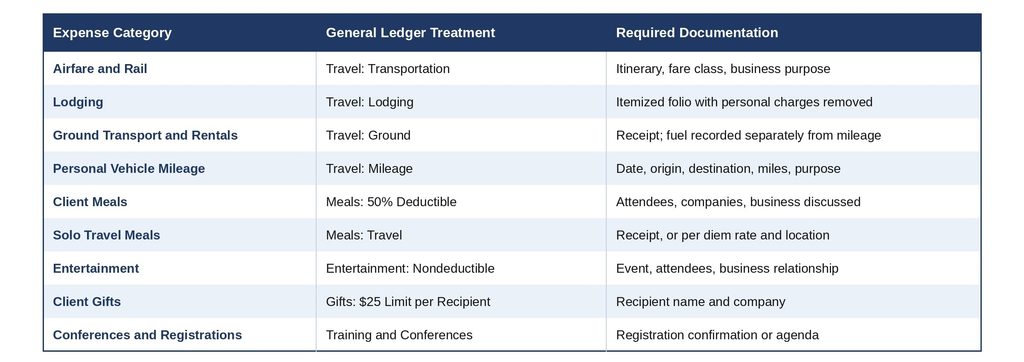
Chart 1: How each expense category post to the general ledger and the documentation accounting requires.
The business purpose field deserves particular emphasis. “Client meeting” communicates nothing of analytical value, whereas “Quarterly pricing review with the Acme Corporation purchasing director” communicates everything I require, including the customer to whom the cost may be allocated for profitability analysis.
Establish a Weekly Cadence
Monthly submissions guarantee a month-end bottleneck. I recommend a disciplined weekly rhythm: travelers submit the prior week’s expenses by Monday at noon, approving managers act within forty-eight hours, and accounting posts and reimbursements by Friday. Automated reminders and an escalation rule for reports older than fourteen days keep the cycle honest. Organizations that adopt this cadence routinely shorten their month-end close by several days because the expense ledger is already current when the period ends.
Senior Management Sets the Standard
Executives are frequently the slowest submitters, and their delays carry disproportionate consequences because executive expenditures tend to be larger, more discretionary, and more heavily scrutinized by auditors and boards.
Senior leaders must follow the identical process, including itemized receipts and a stated business purpose, and their reports should be approved or at least reviewed by another officer peer, the chief financial officer, or a board designee rather than by a subordinate. When the field sales force sees the president submitting on Monday morning, compliance ceases to be a negotiation.
Leaders must also separate personal and business charges with rigor. A mixed folio or a personal purchase on the corporate card forces my team to establish a receivable from the employee, which is precisely the exception processing that delays the close.
Build Policy Into the Software
Written policy functions only when the system enforces it. Configure per diem limits, receipt thresholds, preferred vendors, and the current IRS standard mileage rate directly into the platform so that out-of-policy items are flagged before submission rather than discovered during review. Integrate the expense tool with the general ledger, so approved reports post without rekeying. Every manual touchpoint you eliminate represents a processing day you recover.
The Standard I Hold
A well-administered expense process should be virtually invisible: the salesperson captures the receipt in seconds, selects the correct category, writes a specific business purpose, and submits weekly; the executive does precisely the same; and accounting reviews exceptions rather than every line, and the books close on schedule with costs assigned to the correct accounts, customers, and departments. That is the standard I build for every client, and it is the standard your road warriors can meet beginning next Monday.
Note: The information in this article is current as of the date it was written and may now have changed due to product and services updates. Cited brands are the property of their owners and their links are listed below. MIG did not receive compensation from the brands cited.
References
Expensify (a great fit for small businesses)
-MIG
© Management Insights Group, LLC
Dallas/Fort Worth Texas Office