
By Robert Majdak Sr. MBA
Management Insights Group, LLC
July 1, 2026
A weak credit rating quietly taxes every decision a small business makes. It raises the cost of capital, narrows the field of willing lenders, and forces owners to lean on personal guarantees long after the company should stand on its own. I have advised enough executives through this problem to know it is rarely solved by a single fix. It is solved by discipline, applied consistently, across a small number of levers that actually move the score. Below are the three methods I see today’s CEOs use most effectively, and the reasoning behind each.
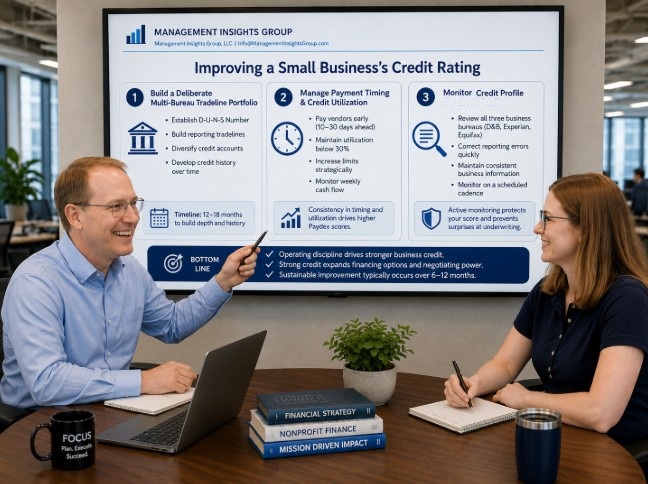
1. Build a Deliberate, Multi-Bureau Tradeline Portfolio
The single biggest mistake I encounter is an owner who pays every bill on time and still has no credit profile to show for it. Payment discipline only counts if the vendor actually reports it. Dun & Bradstreet, Experian Business, and Equifax Business each maintain separate files, and a business needs a visible, reporting history on all three, not just one. The playbook I recommend to clients is straightforward: open your D&B file and secure a D-U-N-S Number at no cost, then establish three to five net-30 vendor accounts with suppliers known to report, such as major office-supply and industrial distributors. Use each account monthly and let the payment history accumulate. After ninety days of clean activity, layer in a business credit card that reports to at least two bureaus, and after six months, add a secured line of credit through a community bank or credit union. This is not a quick fix. It is a twelve-to-eighteen-month build. But depth and diversity across account types is exactly what scoring models reward, and it is the only durable path to a strong Paydex or Intelliscore result.
2. Manage Payment Timing and Utilization With Precision
Once tradelines exist, how you use them matters as much as whether you have them. I push clients to treat their due dates as a ceiling, not a target. Paying an invoice ten to thirty days ahead of terms, consistently, is the fastest lever available to move a Dun & Bradstreet Paydex score into the eighty-plus range that most lenders and landlords screen for. Alongside timing, utilization deserves equal attention. I hold my own clients to a firm ceiling: never carry more than thirty percent of any credit line’s available balance, and pay it down before the statement closes rather than after. When a limit is being approached regularly, the correct move is to request an increase rather than let utilization run hot, since a higher ceiling against a stable balance improves the ratio without adding risk. This is a habit, not a project. It requires a cash-flow rhythm built around credit obligations, tracked weekly, not discovered at month’s end.
3. Monitor the Profile Actively and Correct Errors Fast
Business credit does not update in real time, and it does not announce its own mistakes. I have seen otherwise healthy companies denied financing because of a reporting error, a mismatched business address, or a stale public record that no one caught for months. The CEOs who protect their score treat monitoring as a standing item, not an annual task. That means subscribing to reports across all three major bureaus, reviewing them on a set cadence, and disputing inaccuracies the moment they surface rather than waiting for a lender to flag them during underwriting. It also means keeping company information, legal name, address, EIN, and ownership structure, identical across every filing and every bureau, since inconsistency is one of the most common reasons a profile gets fragmented or flagged. Active governance of the file is what separates owners who understand their financing position at all times from those who find out their score is weak while sitting across from a loan officer.
The Bottom Line
None of these three methods produces results overnight, and I tell every client the same thing at the outset: a credit rating is a byproduct of operating discipline, not a target you chase directly. Build the tradeline portfolio with intent, manage timing and utilization as a weekly discipline rather than a monthly afterthought, and govern the profile actively across all three bureaus. Businesses that commit to this sequence typically see a meaningful, measurable improvement within six to twelve months, and they earn something more valuable than the number itself: the standing to negotiate financing on their own terms.
-MIG
© Management Insights Group, LLC
Dallas/Fort Worth Texas Office