
By Robert Majdak Sr. MBA
Management Insights Group, LLC
October 4, 2026
How GAAP governs the cost of technology you build for yourself
Every organization I advise now builds technology for its own operations. Client portals, workflow automation, analytics dashboards, and the corporate website each represent substantial investment, and leadership consistently asks me the same question: does this spending belong on the balance sheet or the income statement? The answer materially affects reported earnings, EBITDA, debt covenant compliance, and valuation. In this article, I explain how generally accepted accounting principles govern these costs and why the Financial Accounting Standards Board has fundamentally rewritten the rules.
Defining Internal-Use Software
Accounting Standards Codification (ASC) Subtopic 350-40 governs software that an entity acquires, develops, or modifies solely to meet internal needs, with no substantive plan to market it externally [1]. Software intended for sale, lease, or licensing falls under Subtopic 985-20, a separate and considerably more restrictive framework [2]. Hosted platforms that deliver services to customers, including software-as-a-service offerings, still qualify as internal-use because customers never take possession of the code [1]. Classification drives every subsequent judgment, so I resolve it first on every engagement.
The Legacy Three-Stage Model
Since 1998, GAAP has required companies to sort development costs into three sequential stages [3]. Preliminary project costs, such as conceptual design and evaluation of alternatives, were expensed. Application development costs, such as coding, configuration, installation, and testing, were capitalized. Post-implementation costs, such as training and maintenance, were expensed. That model presumed waterfall development, in which design concluded before coding commenced. Agile teams design, build, and test continuously, so the stage boundaries rarely existed in practice, and preparers applied the framework inconsistently [4].
ASU 2025-06 and the Probable-to-Complete Threshold
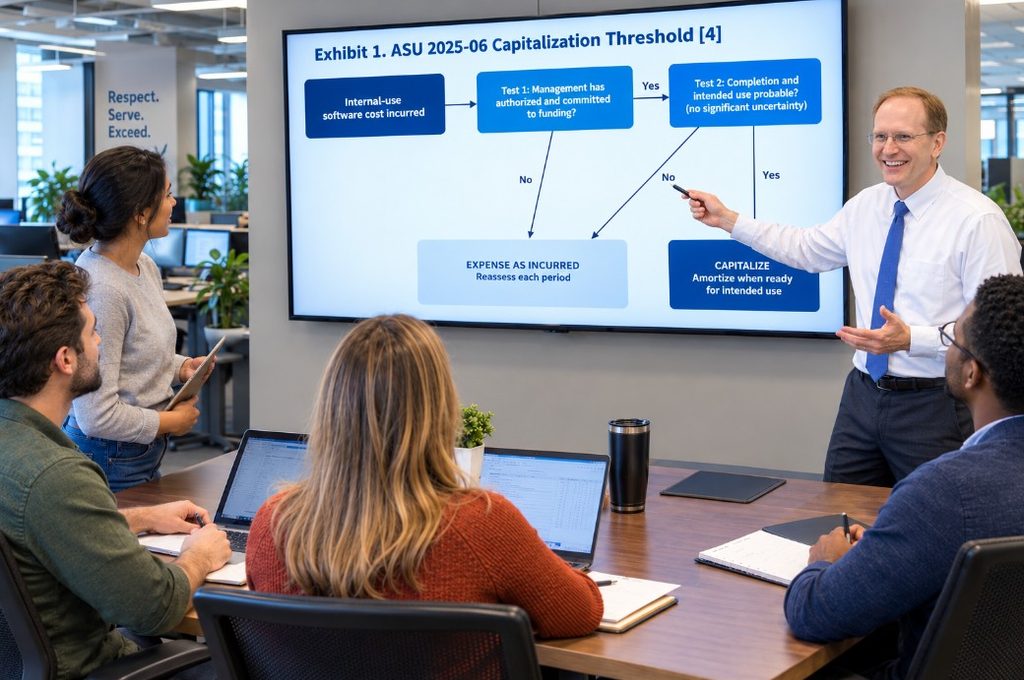
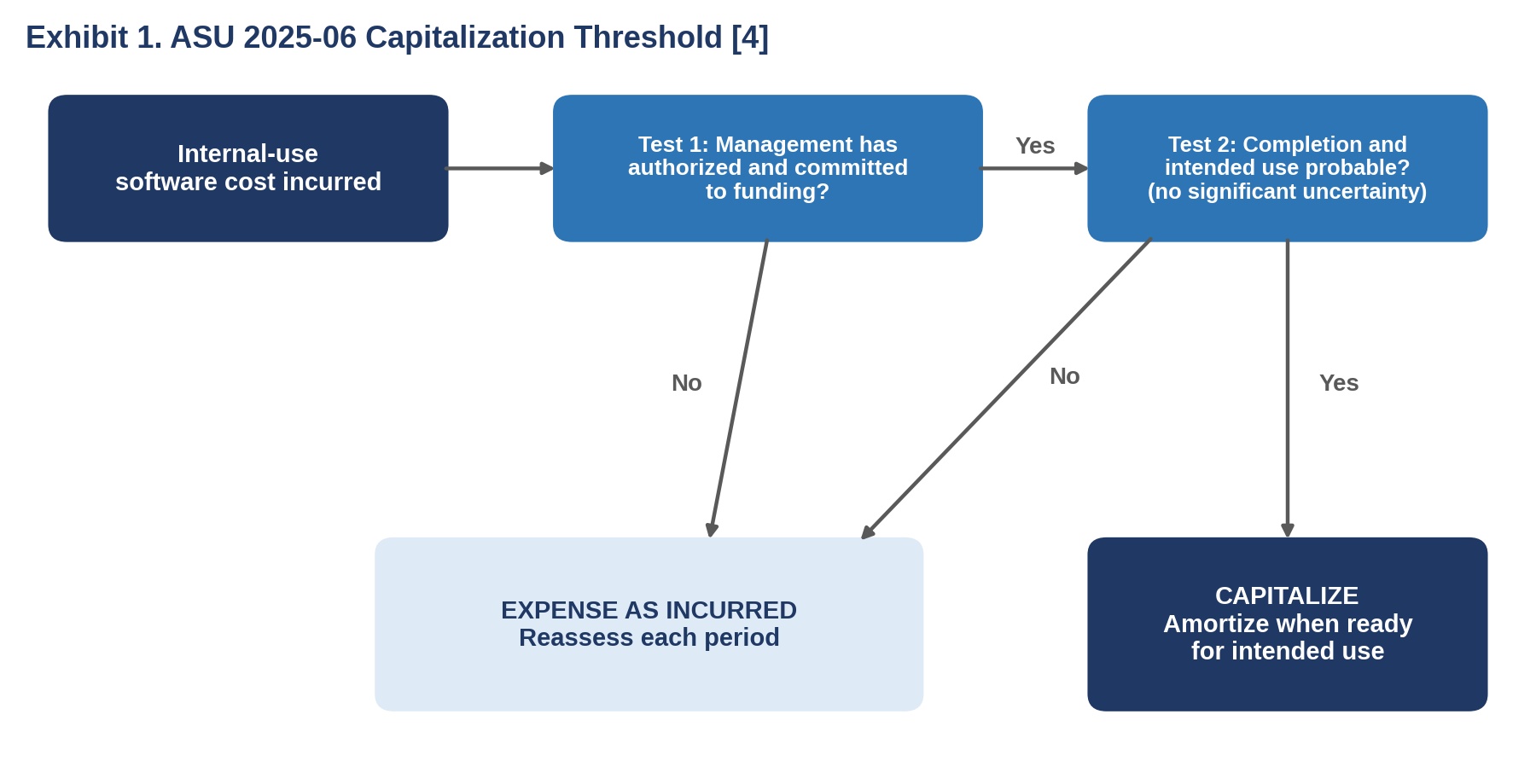
In September 2025, the FASB issued Accounting Standards Update 2025-06, which eliminates every reference to project stages [4]. Under the amended guidance, capitalization begins only when two conditions are simultaneously satisfied. First, management with the relevant authority has authorized and committed to funding the project. Second, it is probable that the project will be completed and the software will perform its intended function. When significant development uncertainty exists, such as novel technology or unresolved performance requirements, the threshold is not met, and costs remain period expenses until that uncertainty is resolved [4].
What Qualifies for Capitalization
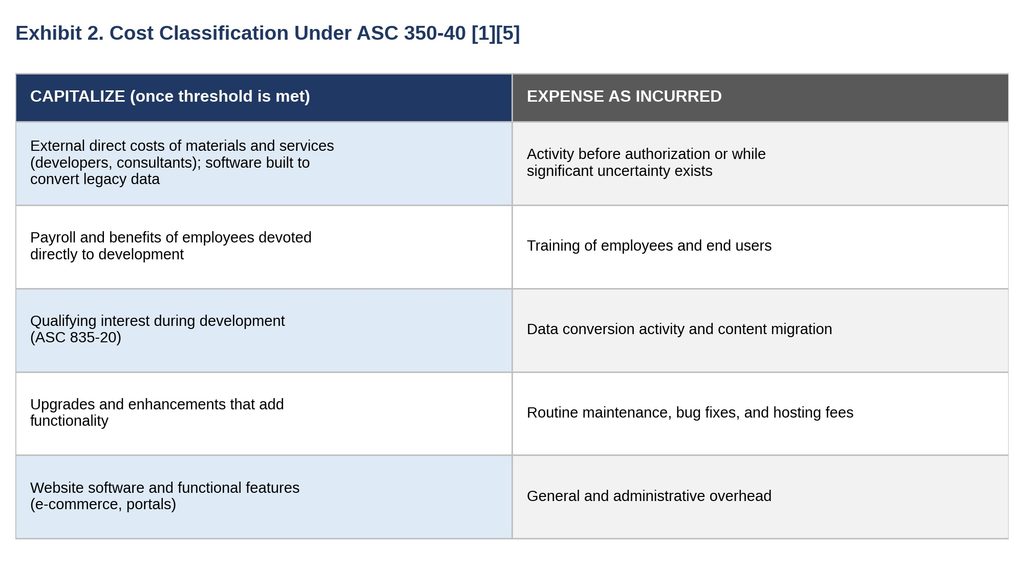
Once the threshold is met, I capitalize external direct costs of materials and services, payroll and benefits for employees devoted directly to development, and qualifying interest under ASC 835-20 [1][5]. Software built to convert legacy data qualifies, but the conversion activity itself does not. Training, data conversion, general and administrative overhead, and routine maintenance remain expenses regardless of timing [1]. Upgrades and enhancements qualify only when it is probable they will deliver additional functionality; recurring fixes that merely preserve existing capability never do [1].
Exhibit 2. Cost Classification Under ASC 350-40 [1][5]
Website Development Costs
Website development previously resided in its own Subtopic, 350-50 [6]. ASU 2025-06 supersedes that guidance and consolidates website costs into Subtopic 350-40, so the same threshold now governs both [4]. Developing the site’s underlying software and functional features, such as e-commerce, donor registration, or customer portals, follows the capitalization analysis. Ongoing content updates and hosting fees remain operating expenses [6].
Amortization, Impairment, and Disclosure
Capitalized costs are amortized on a straight-line basis, unless another systematic method better reflects the pattern of benefit, beginning when the software is ready for its intended use [1]. In my practice, useful lives typically range from three to five years. I evaluate the asset for impairment under ASC 360-10 whenever events indicate that its carrying amount may not be recoverable, and I write off abandoned projects promptly [1][7]. The amended standard also requires entities to apply the property, plant, and equipment disclosures of ASC 360-10 to all capitalized software [4][7]. The illustration below demonstrates why this distinction matters to anyone reading the financial statements.
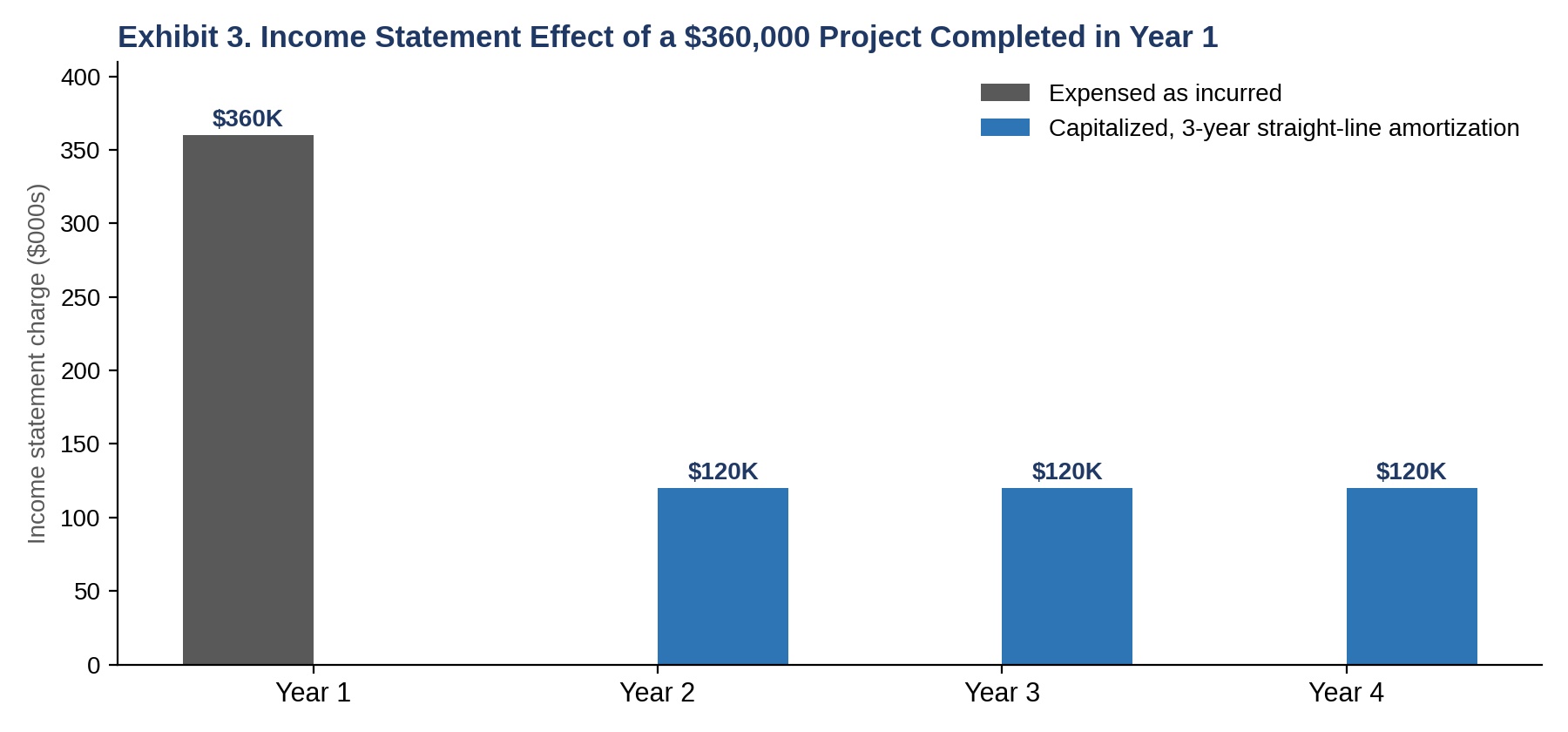
Illustrative only. Assumes the software is placed in service at the end of Year 1. Both approaches recognize the same $360,000 in total; capitalization aligns the expense with the periods that benefit.
Effective Date and Transition
ASU 2025-06 takes effect for annual reporting periods beginning after December 15, 2027, including interim periods within those years, and early adoption is permitted as of the beginning of an annual period [4]. Entities may transition prospectively, retrospectively, or under a modified approach based on each project’s status at adoption [4]. Federal tax treatment follows separate rules: Internal Revenue Code Section 174A, enacted in July 2025, permits an immediate deduction for domestic software development costs in tax years beginning after December 31, 2024 [8]. Book-tax differences therefore require deliberate tracking.
Nonprofit Considerations
ASU 2025-06 applies to not-for-profit entities without modification, but its effects surface differently in their financial statements. Under ASC 958-720, nonprofits report expenses by both function and nature, so amortization must be allocated among program services, management and general, and fundraising [9]. A donor database belongs largely to fundraising; a case-management platform belongs to program services. Because capitalization spreads cost across the periods that benefit, it prevents a single technology investment from distorting the program expense ratio that donors, evaluators, and grantmakers scrutinize.
When donors restrict gifts to fund a system, the organization releases those restrictions when the software is placed in service, absent explicit donor stipulations to the contrary [10]. The documented in-service date therefore governs both amortization and the reclassification of net assets. Pro bono development is recognized as contributed services when it creates or enhances a nonfinancial asset [11], and donated software licenses are contributed nonfinancial assets subject to separate presentation and disclosure [12].
Organizations with federal awards must also satisfy the Uniform Guidance, which imposes its own rules on capital expenditures, prior approval, and cost recovery, and which excludes capital expenditures from indirect costs [13]. GAAP capitalization and grant allowability are distinct analyses that auditors test independently. The Section 174A deduction rarely matters to a tax-exempt organization unless the software supports an activity that generates unrelated business taxable income [8][14]. A nonprofit with a June 30 year-end first applies the new standard in the fiscal year beginning July 1, 2028.
My Recommendation
I direct every client to formalize project authorization in writing, whether by executive approval or board resolution, document the probable-to-complete assessment contemporaneously, and track developer time by project from the first sprint. Organizations that build this discipline now will adopt the new standard seamlessly, defend their judgments under audit, and present results that accurately reflect the value of the technology they own. Software is a strategic asset, and I insist that it be accounted for as one.
References
[1] Financial Accounting Standards Board (FASB). Accounting Standards Codification (ASC) 350-40, Intangibles—Goodwill and Other—Internal-Use Software. Norwalk, CT: FASB.
[2] FASB. ASC 985-20, Software—Costs of Software to Be Sold, Leased, or Marketed. Norwalk, CT: FASB.
[3] American Institute of Certified Public Accountants (AICPA). Statement of Position 98-1, Accounting for the Costs of Computer Software Developed or Obtained for Internal Use (1998); codified in ASC 350-40.
[4] FASB. Accounting Standards Update No. 2025-06, Intangibles—Goodwill and Other—Internal-Use Software (Subtopic 350-40): Targeted Improvements to the Accounting for Internal-Use Software (September 2025).
[5] FASB. ASC 835-20, Interest—Capitalization of Interest. Norwalk, CT: FASB.
[6] FASB. ASC 350-50, Intangibles—Goodwill and Other—Website Development Costs (superseded by ASU 2025-06 upon adoption).
[7] FASB. ASC 360-10, Property, Plant, and Equipment—Overall. Norwalk, CT: FASB.
[8] Internal Revenue Code § 174A, Domestic Research or Experimental Expenditures, added by Public Law 119-21 (One Big Beautiful Bill Act), enacted July 4, 2025.
[9] FASB. ASC 958-720, Not-for-Profit Entities—Other Expenses. Norwalk, CT: FASB.
[10] FASB. Accounting Standards Update No. 2016-14, Not-for-Profit Entities (Topic 958): Presentation of Financial Statements of Not-for-Profit Entities (August 2016); codified in ASC 958.
[11] FASB. ASC 958-605, Not-for-Profit Entities—Revenue Recognition (contributed services). Norwalk, CT: FASB.
[12] FASB. Accounting Standards Update No. 2020-07, Not-for-Profit Entities (Topic 958): Presentation and Disclosures by Not-for-Profit Entities for Contributed Nonfinancial Assets (September 2020).
[13] Office of Management and Budget. Uniform Administrative Requirements, Cost Principles, and Audit Requirements for Federal Awards, 2 CFR Part 200, including §§ 200.1, 200.436, and 200.439 (as revised April 2024, effective October 1, 2024).
[14] Internal Revenue Code §§ 511–513, Taxation of Business Income of Certain Exempt Organizations (unrelated business taxable income).
-MIG
© Management Insights Group, LLC
Dallas/Fort Worth Texas Office