

By Robert Majdak Sr. MBA
Management Insights Group, LLC
November 23, 2026
Recognizing the Moment an Accountant on Staff Stops Being an Expense and Starts Being an Asset
Every business owner I have advised carries an extensive, largely invisible inventory of hats: chief executive, head of sales, human resources director, collections agent, and, almost invariably, bookkeeper of last resort. The owner rarely chooses that final role deliberately; it accumulates by default, one reconciliation and one late-night payroll run at a time. Eventually the arrangement becomes so habitual that the owner mistakes improvisation for prudence. I intend to dismantle that illusion, because the decision to postpone hiring a dedicated accountant is among the most consequential, and most frequently miscalculated, decisions a growing company makes.
The Case Owners Make for Waiting
The arguments for delay are remarkably consistent and entirely sincere, and each contains a legitimate kernel of truth that hardens, over time, into an expensive assumption. The first is affordability: a salaried accountant appears to be a fixed cost the business has not yet earned. The second is technological: modern accounting software, the reasoning goes, has automated the work that once required a professional. The third is episodic: the outside tax preparer reviews everything once a year, so the books must be adequate. The fourth is proprietary: no one understands the business as intimately as its founder. The fifth is temporal: the company will hire an accountant once it is “big enough.”
Each argument collapses under financial scrutiny. Software records transactions; it does not interpret them, challenge them, or forecast their consequences. An annual tax engagement is retrospective by design, examining decisions long after anyone can change them. Intimate operational knowledge is precisely why the owner’s hours are too valuable to spend categorizing expenses. And “big enough” is a threshold that perpetually recedes, because an owner who lacks reliable financial information cannot accurately determine when the company has crossed it.
The Hidden Invoice: The Owner’s Time
The most expensive accountant many companies employ is the one who never appears on the payroll: the owner. A survey reported by CPA Practice Advisor found that small business owners spend roughly 20 hours each week on accounting tasks, and that one in five spends more than 30 hours. Upwork’s survey of 2,272 small business leaders found that they devote approximately 30 percent of their working time to responsibilities outside their core role, the equivalent of roughly 77 working days annually.
Figure 1 puts a price on those hours. The typical accountant earned $81,680 in 2024, according to the Bureau of Labor Statistics. Once you add benefits and payroll taxes, which make up about 30 percent of what an employer spends on each worker, a staff accountant costs about $116,000 a year. Now consider the owner. Twenty hours a week for 50 weeks is 1,000 hours a year. If your time is worth more than $116 an hour, you are already paying more to do the books yourself than you would pay to hire someone. Most owners of growing companies value their time well above that figure.
The real cost is even higher than the math shows. The hours owners give up to bookkeeping are seldom their spare hours. They are often their best hours: the ones they would otherwise spend winning major customers, negotiating with suppliers, developing their managers, or weighing a chance to grow. Every month the owner keeps acting as the company’s bookkeeper, the most important decision-maker in the business is tied up doing its most routine work.
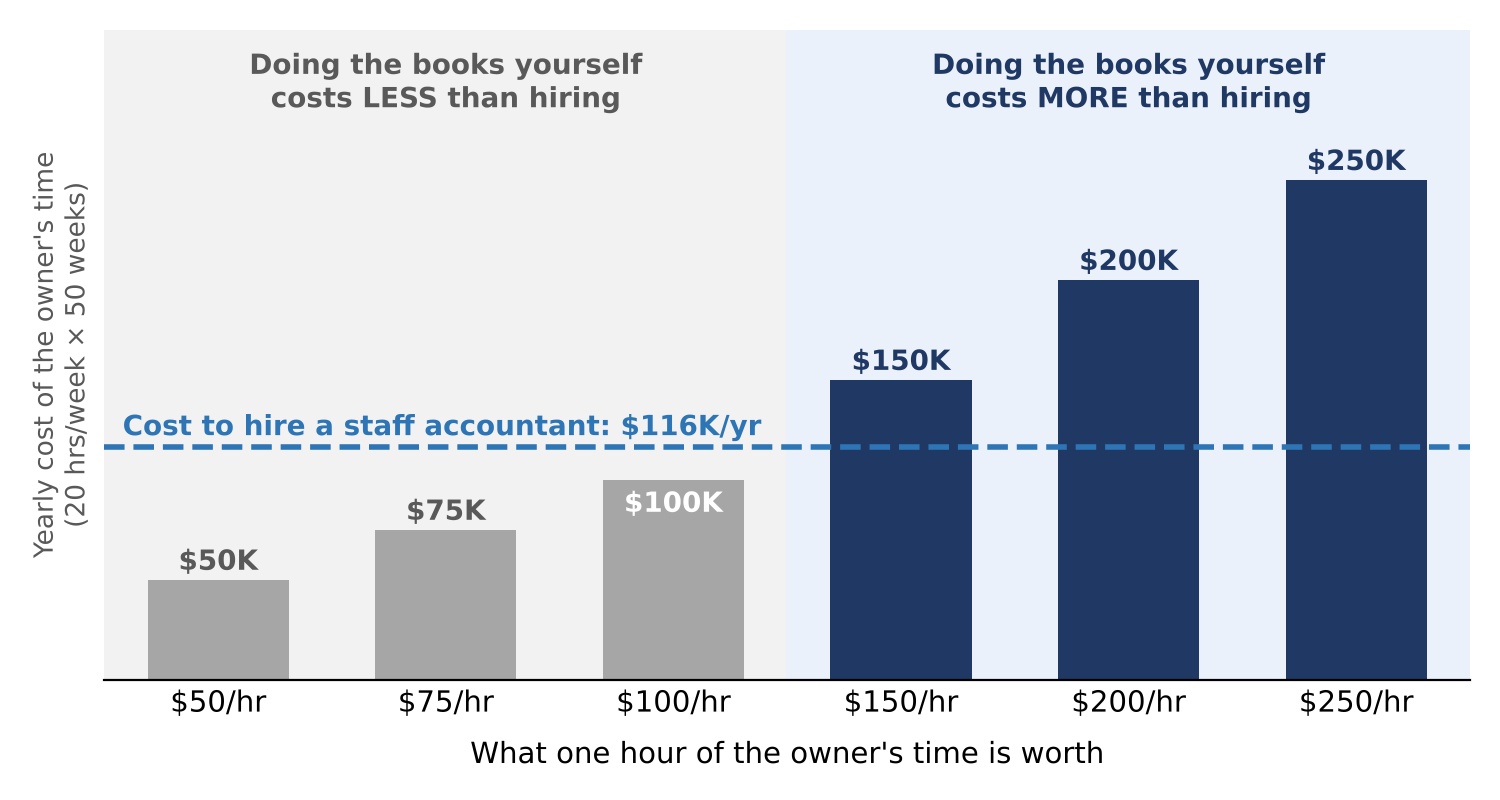
Figure 1. What it costs an owner to keep doing the books. Each bar shows the yearly value of 1,000 owner hours (20 hours a week for 50 weeks) at a given hourly worth. Once an owner’s hour is worth more than about $116, doing the books personally costs more than hiring a staff accountant at roughly $116,000 a year. Sources: BLS Occupational Outlook Handbook (May 2024 median wage of $81,680); BLS Employer Costs for Employee Compensation (June 2025, wages equal 70.2% of total compensation); MIG analysis.
The Price of Errors and Absent Controls
Time is only the visible portion of the cost. SCORE, citing IRS data, reports that roughly 40 percent of small businesses incur a payroll tax penalty each year, averaging $850 to $1,000 per incident, and that in fiscal year 2024 alone the IRS assessed more than 4.4 million employment tax penalties totaling nearly $26.9 billion. Penalties of this kind are almost entirely preventable, which makes them a tax on inattention rather than a legitimate cost of doing business.
The more serious exposure is fraud. The Association of Certified Fraud Examiners’ Occupational Fraud 2024: A Report to the Nations documented a median loss of $141,000 for organizations with fewer than 100 employees, and found that more than half of all cases were associated with a lack of internal controls or the override of existing controls. Small organizations are less likely than larger ones to maintain anti-fraud controls, largely because segregation of duties requires a second, competent set of hands. As Figure 2 illustrates, a single median fraud event exceeds the fully loaded annual cost of the very professional whose presence would most likely have prevented or detected it.
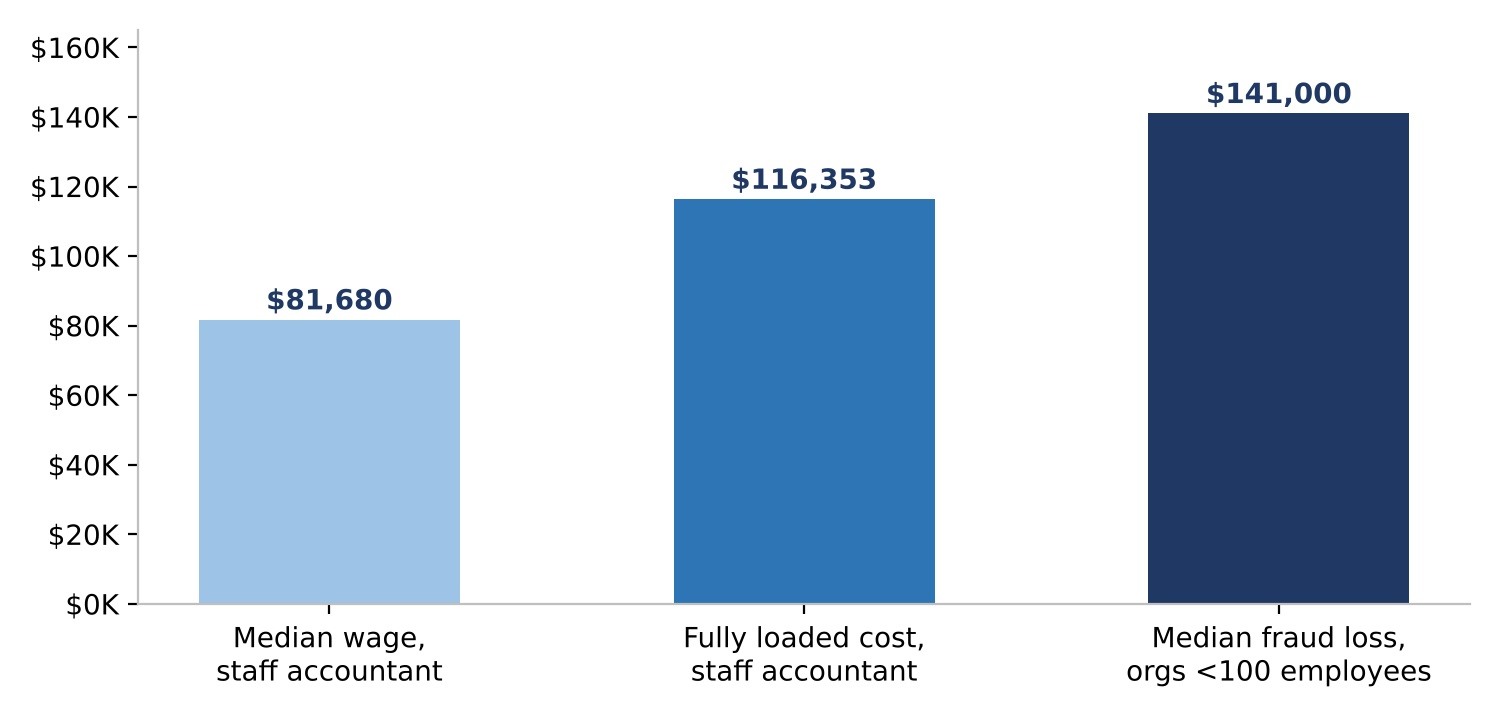
Figure 2. The annual investment in a staff accountant compared with the median occupational fraud loss at organizations with fewer than 100 employees. Sources: BLS (May 2024; June 2025); ACFE, Occupational Fraud 2024: A Report to the Nations.
Cash Is the Scorecard
The JPMorgan Chase Institute’s analysis of 600,000 small businesses found that the median firm holds only 27 cash buffer days, meaning it could cover just 27 days of outflows if inflows stopped entirely; the Institute’s subsequent research found that the median employer business held only 18. SCORE identifies cash flow as the leading cause of small business failure, attributing 82 percent of failures to it. These figures describe enterprises operating with almost no margin for forecasting error, and forecasting is precisely the discipline an owner wearing many hats cannot sustain. A dedicated staff accountant converts the bank balance from a lagging surprise into a managed thirteen-week projection. Beyond forecasting, a dedicated accountant institutes the receivables discipline, vendor-payment sequencing, and monthly variance analysis that transform cash management from a reactive exercise into a deliberate operational capability.
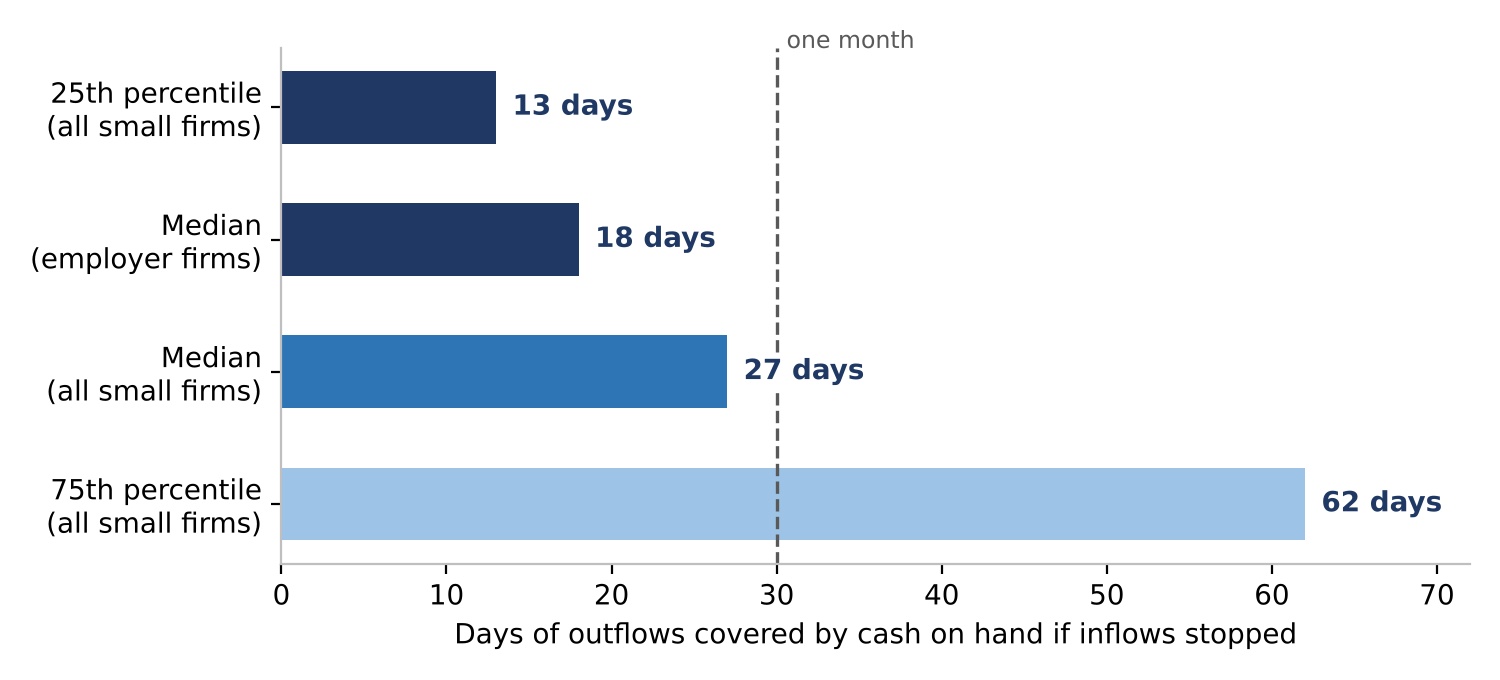
Figure 3. Cash buffer days held by U.S. small businesses: the number of days of outflows a firm could pay from its cash balance if all inflows stopped. Source: JPMorgan Chase Institute, Cash is King: Flows, Balances, and Buffer Days (2016) and its small business payroll research.
Recognizing the Pain Point
The pain point announces itself through a predictable set of symptoms. When three or more of the following describe your company, the question is no longer whether to hire an accountant, but how quickly:
- You personally spend more than ten hours each week on bookkeeping, payroll, invoicing, or reconciliation.
- Your monthly closing process consistently exceeds three weeks, or does not occur at all.
- You have paid a penalty, late fee, or interest charge to a taxing authority within the past twelve months.
- One individual receives, records, deposits, and reconciles cash without independent review.
- A lender, investor, or prospective acquirer has requested financial statements you could not produce within a week.
- You make pricing, hiring, and capital decisions by consulting the bank balance rather than a forecast.
- Revenue is growing, yet you cannot explain with confidence why margins moved last quarter.
The Return on the Hire
A competent accountant does not merely relieve the owner of tedious work; that professional supplies the information architecture on which every other decision depends. Timely, accurate financial statements strengthen lending relationships, accelerate credit decisions, and anchor valuation conversations in evidence rather than optimism, while disciplined payroll and tax compliance eliminates the avoidable penalties that quietly erode profitability. Segregated duties and management review establish the controls the ACFE associates with materially lower losses. Most importantly, the owner reclaims the hours that only the owner can invest: in customers, in people, and in strategy.
For companies that have reached the pain point but not yet the transaction volume to justify a full-time position, a retained or fractional accounting relationship provides an effective bridge, delivering professional discipline at a scale proportionate to current operations. What no company at this stage can afford is the status quo.
Take Off the Hat
The many-hats model is a necessity of the founding phase, not a strategy for the growth phase. Owners who cling to it believe they are saving a salary; in reality, they are paying for that salary several times over in forfeited time, preventable penalties, unguarded cash, and decisions made in the dark. Recognize the symptoms, run the numbers, and hand the ledger to a professional. The most valuable hat you will ever remove is the one that was keeping you from leading your company.
-MIG
© Management Insights Group, LLC
Dallas/Fort Worth Texas Office